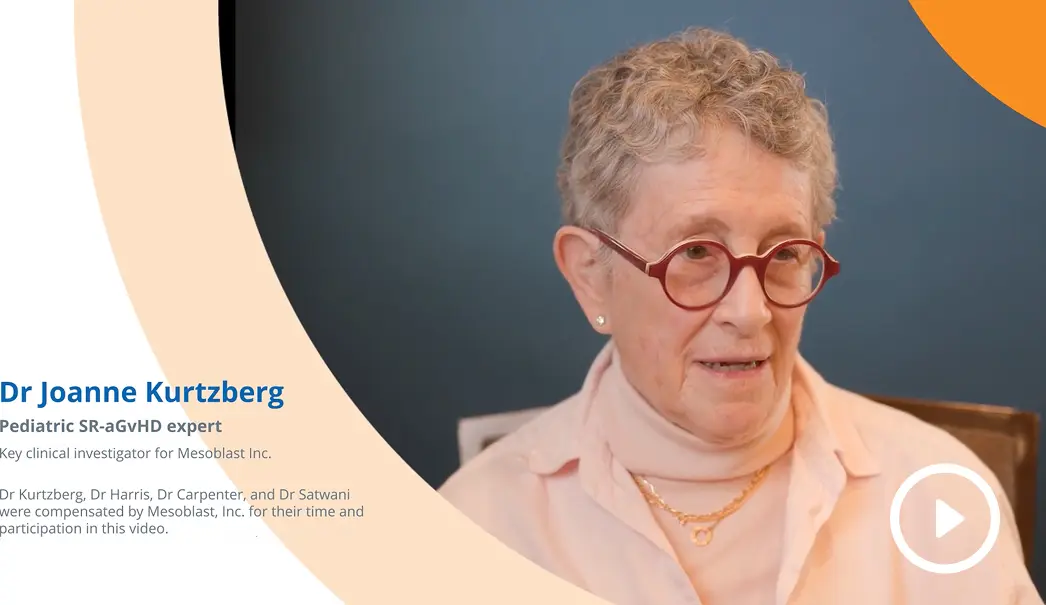


“We treated children who really had no other options, and the majority responded and improved on RYONCIL.”
Dr Joanne Kurtzberg
acute GvHD expert

A study showed that 70% of children improved within 4 weeks.*
See what’s possible with RYONCILRecovery from acute GvHD looks different for everyone. Some signs of progress may be easy to see. Others are slower, happening day by day.But every moment—and every sign of recovery— matters.
Results from the RYONCIL clinical study
In a study, 70% of children with steroid-refractory acute GvHD treated with RYONCIL showed improvement within 4 weeks.* Even very sick children had good results. In fact, many children with the worst cases showed signs of recovery.*
In that same study, about 3 out of 10 children saw all signs of steroid-refractory acute GvHD fully go away. About 4 out of 10 showed improvement with signs of recovery.
70% of children improved within 4 weeks*


Even some of the sickest children got better. This includes children with symptoms of the gastrointestinal, or GI, tract (stomach and intestines), liver and/or skin.
These results offer hope that progress is possible for children and families facing steroid-refractory acute GvHD.
Learn more about how RYONCIL was studied*Results may vary.
“We treated children who really had no other options, and the majority responded and improved on RYONCIL.”
Dr Joanne Kurtzberg
acute GvHD expert
RYONCIL has been proven safe and effective for children 2 months of age and older.
RYONCIL was studied with safety in mind. Today, it is the first and only FDA-approved steroid-refractory acute GvHD treatment for children 2 months of age and older. It is also the only approved option for children under 12 years of age.

As with many IV treatments, side effects happen. The most common side effects of RYONCIL were mild to moderate in nature, including viral or bacterial infectious disorders, infections, fever, bleeding, swelling, stomach pain, and high blood pressure.

Your child’s care team will watch for allergic reactions, including fever, trouble breathing, and blood pressure changes. Certain medicines are given before each infusion to help prevent allergic reactions.

RYONCIL is administered by healthcare professionals in a medical setting. Your child's care team can help monitor and manage side effects.

Learn how your experience with RYONCIL could make a meaningful difference for other patients and families affected by steroid-refractory acute GvHD.
Share your story
Move beyond “what if?” to “what’s next?”
Learn more about the first and only FDA-approved treatment made specifically for children with steroid-refractory acute GvHD.
About RYONCIL
Covered for most families
Learn about a support program that helps families access treatment with RYONCIL.
Get support resourcesHave questions? We have answers
Get answers to common questions about steroid-refractory acute GvHD and treatment with RYONCIL.
Explore Q&A
RYONCIL is a prescription medicine used to treat a condition called steroid-refractory acute graft versus host disease (SR-aGvHD) in children 2 months and older.
Do not receive Ryoncil if you are allergic to DMSO or porcine and bovine proteins (e.g., pigs or cows).
Ryoncil is not recommended if you are pregnant. Talk to your doctor about the risks and benefits of breastfeeding during Ryoncil treatment.
The most common side effects include infections, fever, bleeding, swelling, stomach pain, high blood pressure, vomiting, irregular heartbeat, diarrhea, rash, joint pain, low blood pressure, cough, and trouble breathing.
Tell your doctor about all your medical conditions, allergies, and if you are pregnant or breastfeeding.
You are encouraged to report negative side effects of prescription drugs to the FDA. Visit www.fda.gov/medwatch, or call 1–800-FDA-1088.
For additional information, see full Prescribing Information.

